SIM Cards and eSIM for Tainan
Tainan rewards a working data connection: bus routes, rotating night market schedules and temple opening hours all live on your phone. Here is what the sources say about tourist SIM cards, eSIMs and the backups worth having.
Short answer
Buy a tourist SIM at an airport counter in Taiwan with your passport, or activate an eSIM before you fly. Both work island-wide, including Tainan, and no local registration beyond ID is needed.
SIM Cards and eSIM for Tainan
Tainan is a city where a working phone genuinely changes the day. The big outdoor night markets rotate by day of week, the city buses are free for the first 8 km if you tap an electronic card, and the Tourism Bureau's own pages are the only place the current market schedule is published. None of that is hard, but all of it assumes you can load a page when you are standing on a corner at 18:00 wondering whether the market near you is open tonight. This guide sets out what the sources confirm about tourist SIM cards, eSIMs and the offline backups that make a connectivity failure survivable.
Do You Need a SIM Card or eSIM for Tainan?
Yes, most visitors benefit from local data, because Tainan's practical information lives online and the city's own schedules change. The night market roster rotates by day, the bus fare waiver runs as an annual policy, and the Tourism Bureau updates its attraction pages, sometimes as recently as July 2026. A data connection is how you check any of that on the spot.
The honest framing is that you need data less in Tainan than in Taipei and more than almost anywhere else in Taiwan. The old city is compact and walkable, and the core sights cluster in West Central District and Anping, so navigation errors are cheap. But the things visitors most often get wrong are schedule things: which market is open on a Wednesday, whether Chihkan Tower's late 21:30 closing still applies, whether the museum is shut on its weekly closed day. Those answers are one search away with data and a guessing game without it.
There is also the language layer. Tainan's tourist areas carry increasing bilingual signage as part of city initiatives, but it is not universal, and a translation app with a data connection fills the gap in the smaller shops and temples. Our English in Tainan guide covers what to expect from signage; a data plan is the practical complement to it.

Where Can You Buy a Tourist SIM Card for Tainan?
The main purchase points are the airport arrival counters of Taiwan's telecom carriers, which sell tourist plans on presentation of a passport, plus electronics stores and carrier shops in the cities themselves. Chunghwa Telecom and Taiwan Mobile are the two carriers named in current sources as running airport tourist counters. Plans in the tourist range run from 3 to 30 days with unlimited data, and ID is required at purchase.
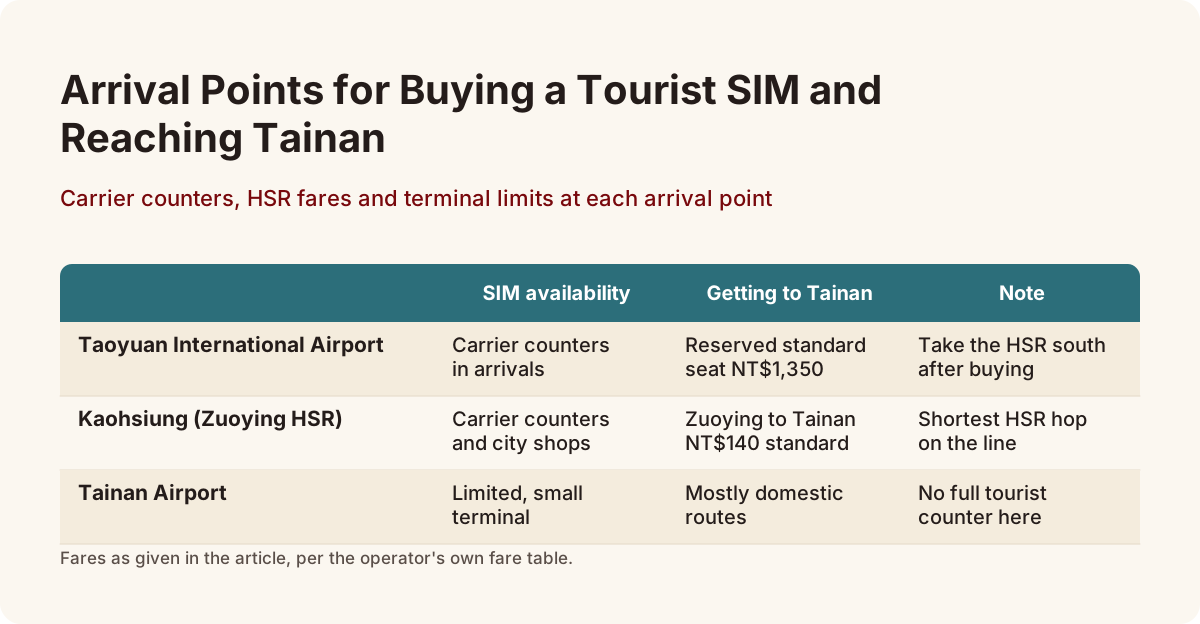
The structural fact that matters most for Tainan specifically is where you land. Tainan Airport is small, mostly domestic and short-haul, and most international visitors do not arrive through it. The typical route is into Taoyuan near Taipei or into Kaohsiung, then onward by High Speed Rail. That means the airport counter you pass is usually Taoyuan's or Kaohsiung's, not Tainan's, and the SIM you buy there works identically in Tainan because Taiwanese mobile coverage is island-wide.
| Arrival point | Tourist SIM availability | Notes for Tainan-bound travelers |
|---|---|---|
| Taoyuan International Airport | Carrier counters in arrivals | Buy here, then take the HSR south; a reserved standard seat to Tainan is NT$1,350 per the operator's own fare table |
| Kaohsiung (Zuoying HSR) | Carrier counters and city shops | Zuoying to Tainan is NT$140 standard, the shortest HSR hop on the line |
| Tainan Airport | Limited, small terminal | Mostly domestic routes; do not plan on a full tourist counter here |
Taiwan High Speed Rail's own fare table lists those fares, and it is worth reading the grid carefully if you check it yourself: the upper-right triangle of the table is Business Car pricing, and a naive read overstates the standard fare by 65 percent. Our Taipei to Tainan and Kaohsiung to Tainan guides carry the verified numbers.
One more arrival-layer fact that pairs with connectivity: the HSR station is not in Tainan. It sits at Shalun in Guiren District, outside the old city, and the Tainan HSR station guide covers the transfer options. A working data connection is genuinely useful at that point, because the next leg is a bus, a train or the free H31 shuttle, and you want the live timetable.

How Do eSIMs Work for Tainan?
An eSIM is a digital profile you download and activate before you travel, and current sources describe it as the popular choice for convenience: no physical swap, no queue at a counter, and the plan can be live the moment you land. Options include pre-purchase online or through carrier and travel apps, with daily or unlimited data tiers. Coverage is strong island-wide, so a Taiwan eSIM serves Tainan the same as anywhere else on the island.
The trade-off is preparation. A physical tourist SIM is bought on arrival with a passport and works immediately, but it costs you twenty minutes at the airport. An eSIM costs you ten minutes at home and nothing at the airport, provided you set it up before you fly and provided your handset supports eSIM profiles. If your phone is older or carrier-locked, the physical SIM remains the safe answer.
For a short Tainan trip, the practical pattern the sources support is simple: buy an eSIM with a duration matching your stay, activate it on the plane or at the gate, and keep your home number reachable through WiFi calling where your home carrier supports it. For a longer trip, or a trip that continues around Taiwan, the airport tourist SIM with its longer validity range is the better fit.
Should You Book Anything Before You Land?
Once your connection is sorted, the things genuinely worth reserving in Tainan are the small-group experiences, not the sights. Temples, old streets and the free-entry sites cost nothing and take no ticket, so the only real booking pressure is on guided walks, ceremonies and day tours with limited seats. The city's own pages state that on-site notices govern prices, so nothing here is a guarantee, and the listings carry the current figures.
A food-and-culture walk is the clearest example of where a reservation earns its keep, because a guided walk with a fixed group size cannot absorb a walk-up crowd the way a temple can. If the plan is to eat through the old city on the first evening, locking the walk in ahead of the trip removes the one thing a data connection cannot fix on the spot.
How Much Data Do You Need in Tainan?
For most visitors, a plan in the tourist range of 3 to 30 days with unlimited data is more than enough, because Tainan's daily data use is light: maps, translation, schedule checks and messaging. There is no verified per-visitor data statistic for Tainan, and none should be invented. What the sources do confirm is that tourist plans are sold as unlimited, which removes the need to budget gigabytes at all.
The honest planning question is not gigabytes, it is days. A weekend in Tainan does not need a 30-day plan, and a two-week circuit of southern Taiwan does not need daily top-ups. The table below is a planning guide based on how the plans are sold, not on any measured usage figure.
| Trip shape | Plan length to look for | Why |
|---|---|---|
| Weekend in the old city | 3 to 5 days | Covers arrival to departure with margin |
| Three to four days with day trips | 5 to 8 days | Qigu, Yanshui and Guanziling add map-heavy days |
| One to two weeks around Taiwan | 10 to 15 days | One plan covers Tainan plus onward cities |
| Long stay | 30 days | The longest standard tourist range named in sources |
Two Tainan-specific uses of data punch above their weight. The first is the night market schedule: the big outdoor markets rotate, Friday is the only night all three run, and the city updates its own pages, so the check-before-you-go habit needs a connection. Our Tainan night markets guide carries the verified day-by-day table. The second is the bus system: the first 8 km are free with an electronic card, and the city's own bus site spells out the tap-on, tap-off requirement that visitors miss.
Can You Just Roam on Your Home Plan?
Roaming works in Taiwan on most major international plans, but current sources describe it as the expensive option relative to local tourist plans, and none of them prices a specific roaming tariff for Tainan. The structural facts are verified: Taiwan's mobile coverage is strong island-wide, and both local SIMs and eSIMs serve the whole island. Whether roaming makes sense depends entirely on your home carrier's rates, which you must check with that carrier.
What can be stated with confidence is the shape of the decision. If your home plan includes Taiwan at no extra charge, as some regional Asian plans do, roaming is the zero-effort answer and no purchase is needed. If your home carrier charges a daily roaming fee, a single tourist plan for the whole trip will usually cost less than a week of daily fees, though the exact comparison belongs to your carrier's price list and not to this page.
There is one Tainan-specific wrinkle worth knowing before you decide. The city's bus fare waiver requires a local electronic card, an EasyCard, iPASS, iCash 2.0 or a Citizen Card, and that is a separate purchase from your SIM. The card question, where to buy one and what it pays for, is covered in our cash and cards in Tainan guide, and the fare rules themselves are published on the city's own bus site, which states that trunk and branch buses are free for the first 8 km with those cards and that the waived base fare is NT$26.
What About WiFi and Offline Backups in Tainan?
Free WiFi exists in Tainan's public facilities, tourist areas and convenience stores, but no source verifies a complete city-wide free WiFi network, and the honest advice is to treat WiFi as a backup rather than a plan. The offline layer that matters is downloads: offline maps, saved pages for the sights you will visit, and screenshots of bus routes. None of those need a connection once made.
The offline habit earns its keep at specific moments. The night market table, once screenshotted, answers the evening's question without a signal. The HSR fare, once known, does not change. And the handful of opening hours that shape a day, Chihkan Tower's unusual 21:30 close among them, can all be saved the night before over hotel WiFi.
| Backup | What it covers offline | Where to prepare it |
|---|---|---|
| Offline map of Tainan | Navigation in the old city and Anping | Download at your hotel before the day starts |
| Night market day table | Which market is open tonight | Screenshot from our night markets guide |
| Attraction hours and prices | Chihkan Tower 08:30 to 21:30, Chimei Museum closed Wednesdays | Save the verified table from our attractions overview |
| Bus route numbers | The routes to Anping and the HSR station | Save before leaving the hotel |
The city's own climate data is also worth having offline, because it shapes what a data connection is for. The Central Weather Administration's 1991 to 2020 normals for Tainan show that October is the driest month by wet days, 2.8, while still averaging 30.8C maxima, and that August brings 466 mm of rain across 16 wet days. In the wet months a connection is how you check a typhoon advisory; in the dry half of the year it is mostly for schedules. Our Tainan weather and typhoon season guides carry the full verified tables.

Does Coverage Reach Outside the City?
Yes, sources describe Taiwan's mobile coverage as strong island-wide, and that includes the rural districts Tainan travelers visit: the Qigu lagoon coast, the Yanshui festival town, the Guanziling hot spring area and the Baihe lotus fields. No source gives a district-by-district coverage map, so treat the island-wide statement as the verified claim and expect the usual reality of weaker signal in deep valleys and on the water.
The day trips are where this matters. A boat on the Sicao Green Tunnel or a drive out to the salt flats is not the place to discover a dead zone, though in practice the lagoon coast is flat and well-populated. The pattern worth planning around is simple: load the day's route before leaving the hotel, and let the connection be a bonus rather than a dependency.
For travelers building the coast into the trip, the boat ride itself is one of the few things in Tainan where advance booking earns its place.
The same logic applies to getting around without a car. The bus pass bundled with an attraction ticket is a low-cost way to cover the HSR station link and the sight circuit in one purchase, and it pairs naturally with the electronic card the bus system already requires. For a traveler who has just sorted a data plan, it closes the loop: connection for the schedules, pass for the rides.
What Should You Do on Arrival Day?
Buy or activate your plan before you need it, not when you need it. The verified sequence for most Tainan-bound travelers is: land at Taoyuan or Kaohsiung, buy a tourist SIM at the carrier counter with a passport or activate a pre-purchased eSIM, then board the HSR south with the connection already live. The fare from Taipei is NT$1,350 standard reserved, from Zuoying it is NT$140, both from the operator's own table.
Arrival day is also when the offline layer pays for itself, because it is the day with the most moving parts. The HSR station at Shalun is outside the old city, the transfer to the center is a bus, a train or the free H31 shuttle for HSR ticket holders, and hotel check-in times vary. A phone that works from the gate turns all of that into a sequence of quick checks.
The last thing worth knowing is that Tainan's connectivity questions are almost never urgent. The city is forgiving, the getting around Tainan options are legible, and the worst realistic outcome of a connectivity failure is eating at a market that is open anyway, because Siaobei Night Market is indoors and runs every day from 12:00 to midnight, which makes it the wrong-night and wet-weather answer in one.

What Is the One Tainan Experience Worth Booking Ahead?
The experiences that genuinely need advance planning are the small-group cultural ones, and the tea ceremony is the clearest case: a 90-minute oolong ceremony with limited seats, rated 5 from 35 reviews on the operator's live listing, from $62.93 per person. Temples and old streets take no booking at all, so the reservation energy is best spent here rather than on sights that cannot sell out. The listing carries the current price and availability.
The broader point is that connectivity in Tainan serves the trip, it is not the trip. A data plan buys you live schedules and translation; the slow, seated, human experiences are what the schedules get you to. The Tainan Travel Guide homepage carries the full picture of what the city offers, from the Dutch-era forts to the lagoon coast, and every one of those pages assumes nothing more than a phone that works.
Common Questions About SIM Cards and eSIM for Tainan
Do I need a SIM card or eSIM for Tainan?
Most visitors benefit from one, because Tainan's practical information, night market days, bus rules and opening hours, lives online and changes. A data connection lets you check it on the spot.
Where can I buy a tourist SIM card for Tainan?
At carrier counters in the arrival halls of Taiwan's international airports, with a passport as ID. Chunghwa Telecom and Taiwan Mobile are the carriers named in current sources as running tourist counters. Plans run 3 to 30 days with unlimited data.
Is an eSIM better than a physical SIM for Tainan?
An eSIM avoids the airport queue and can be live on landing, but it needs a compatible handset and setup before you fly. A physical SIM works for any phone and is bought on arrival. Coverage is identical, island-wide.
Does Tainan Airport sell tourist SIM cards?
Tainan Airport is small and mostly domestic, and most international visitors arrive through Taoyuan or Kaohsiung instead. Plan to buy at one of those airports, or use an eSIM.
How much data do I need in Tainan?
Tourist plans are sold as unlimited, so the question is plan length, not gigabytes. Match the plan to your trip: a 3 to 5 day plan covers a weekend, a 10 to 15 day plan covers a circuit of the island.
Can I use WiFi instead of a SIM in Tainan?
WiFi exists in public facilities and convenience stores, but treat it as a backup. Download offline maps, screenshot the night market table and save your attraction hours over hotel WiFi before each day.
The connected traveler in Tainan has a small advantage: live schedules, translation and the bus fare rules in a pocket. The disconnected traveler still eats well and sees the forts, because most of the city costs nothing and takes no ticket. Get the SIM or eSIM sorted at the airport, build the offline layer the first evening, and spend the rest of the trip looking up from the phone.