Tainan Weather Month by Month
Tainan's weather splits cleanly in two: a hot, wet summer half and a dry, warm winter half. The Central Weather Administration's 1991 to 2020 normals for the city tell you exactly where the line falls.
Short answer
October to March is Tainan's dry, comfortable half of the year, while May to September carries close to three-quarters of the annual 1,760.6 mm of rain. August is the wettest month at 466.1 mm and December the driest at 16.2 mm.
Tainan sits inside Taiwan's tropics, and its climate record behaves like a tropical record should: the year divides into a hot, wet summer half and a dry, warm winter half, with very little in between. The Central Weather Administration's published climate normals for station 467410, covering the 30 years from 1991 to 2020, give the city an annual mean temperature of 24.6C, an annual mean maximum of 29.0C, and 2,185 hours of sunshine a year. What those averages hide is the shape of the year, which is the part a visitor actually plans around. The rain does not spread itself evenly. It arrives almost entirely in the summer.
This page works through the record month by month, then turns it into planning advice: when the rain falls, how hot it gets, where typhoon risk sits, and what the climate means for the way you eat and move around the city. Every figure here comes from the Central Weather Administration's own normals table, unless stated otherwise. Nothing here depends on having stood in the city; it depends on what the record says.
What Is Tainan Weather Like Month by Month?
Tainan's year runs from a mild, dry January at a mean of 17.9C with 20.7 mm of rain, through a steadily building spring, into a hot and very wet June to August, then back down through a dry, warm autumn to a December mean of 19.6C with only 16.2 mm of rain. August is the wettest month at 466.1 mm across 15.8 wet days. October is the driest by wet days, at 2.8.
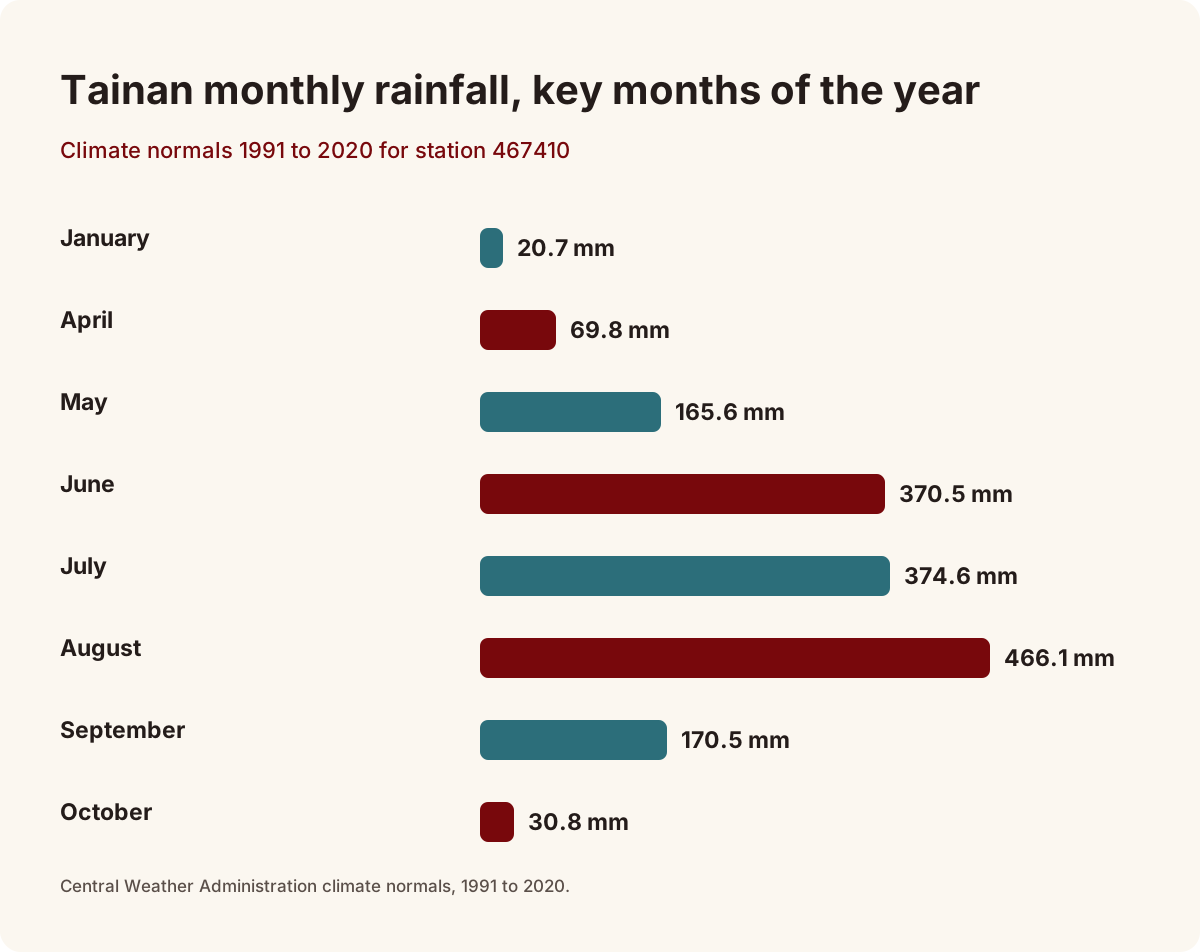
The full table below is the spine of this page. The rainfall column is the one to read first, because it is far more lopsided than the temperature column. Rain climbs from 69.8 mm in April to 165.6 mm in May, then to 370.5 mm in June, and peaks at 466.1 mm in August before falling away sharply to 170.5 mm in September and 30.8 mm in October.
| Month | Mean C | Mean max C | Rain mm | Wet days | Days over 30C | Humidity % |
|---|---|---|---|---|---|---|
| January | 17.9 | 23.0 | 20.7 | 3.8 | 0.0 | 75.5 |
| February | 18.9 | 24.0 | 21.6 | 4.1 | 0.9 | 75.8 |
| March | 21.6 | 26.6 | 30.4 | 4.2 | 4.1 | 74.1 |
| April | 24.9 | 29.3 | 69.8 | 5.9 | 14.9 | 75.0 |
| May | 27.4 | 31.4 | 165.6 | 9.0 | 25.2 | 75.9 |
| June | 28.8 | 32.4 | 370.5 | 12.1 | 26.2 | 77.6 |
| July | 29.3 | 33.0 | 374.6 | 13.0 | 28.9 | 76.5 |
| August | 28.9 | 32.6 | 466.1 | 15.8 | 27.6 | 78.4 |
| September | 28.5 | 32.4 | 170.5 | 8.5 | 27.8 | 75.5 |
| October | 26.3 | 30.8 | 30.8 | 2.8 | 23.6 | 73.6 |
| November | 23.4 | 28.1 | 23.8 | 2.4 | 6.1 | 75.1 |
| December | 19.6 | 24.4 | 16.2 | 3.0 | 0.5 | 74.5 |
Two things stand out. First, the humidity barely moves: it stays in a narrow band between 73.6 and 78.4 percent all year, so a Tainan summer is not just hot, it is consistently humid heat. Second, the temperature floor is high. Even the coldest month, January, averages a maximum of 23.0C. Tainan never has a cold month in the sense a European or North American city does, and our page on what is Taiwan's coldest month puts that in island-wide context.
Spring, March to May, is the transition. March is still pleasantly dry at 30.4 mm, April begins to warm past 29C maxima on nearly half its days, and May is when the rain first arrives in earnest. If you are choosing between spring months, March is the safer bet on paper: 26.6C maxima, four wet days, and almost no days over 30C.
When Is the Rainy Season in Tainan?
The wet season runs from May to September, which together carry close to three-quarters of Tainan's annual 1,760.6 mm of rain. June, July and August are the core of it, with 370.5 mm, 374.6 mm and 466.1 mm respectively. The transition is abrupt rather than gradual: April averages 69.8 mm and June averages 370.5 mm, with May's 165.6 mm sitting in between.
The record shows a jump, not a drift. Between April and June the monthly rainfall more than quintuples, and the number of wet days goes from 5.9 to 12.1. This is the pattern usually described in Taiwan as the plum rain period followed by the summer storms, but what is verified here is the shape itself: a sharp ramp from April through June, a saturated July and August, and an equally sharp drop in September, when rainfall falls to 170.5 mm even though the temperature barely changes.
That September drop matters for planning. September keeps summer heat, with a mean maximum of 32.4C and 27.8 days over 30C, but it loses more than half of August's rain. A late-September trip is climatically a different proposition from an early-August one, even though both sit inside the hot half of the year.

If your dates are flexible and you want to see the city on foot, this is the section that should push you toward October or November, or toward February and March. A walking-heavy itinerary is a different experience in 15.8 wet days than in 2.4. Our best time to visit Tainan page folds the festival calendar into the same decision, and our rainy day in Tainan guide lists the indoor options, including the museums and the covered Siaobei Night Market, for the days the table predicts.
How Hot Does Tainan Get?
Tainan records 185.8 days a year above 30C, and from April to October it passes 30C on most days. July is the hottest month at a mean of 29.3C and a mean maximum of 33.0C. Even October averages 30.8C maxima, so heat is a factor of Tainan travel for seven months of the year, not two.
The heat column is steadier than the rain column. From May to September, every month averages more than 25 days over 30C. But the shoulder months are the ones visitors underestimate. April already has 14.9 days over 30C, and October still has 23.6. Only November, with 6.1, and the winter months, with almost none, give real relief.
The practical consequence is about the shape of a day. In the hot half of the year, the workable pattern is early mornings and evenings outdoors, with the middle of the day given over to museums, temples, cafes and lunch. The city's own opening hours partly support this: Chihkan Tower stays open until 21:30 daily, which the Tourism Bureau's page for the site confirms, making it one of the few historic sites in Tainan that can be seen after dinner, once the heat has gone. The Tainan Art Museum runs until 21:00 on Saturdays for the same reason.

Hydration and shade are not optional in summer. Convenience stores, which sell chilled and filtered water, are everywhere in Tainan, and most locals do not drink tap water unboiled; bottled and filtered water are the standard. For moving between stops, the city's buses are free for the first 8 km with an electronic card, and the getting around Tainan page explains the tap-on, tap-off mechanics, which are worth learning before a hot afternoon.
When Is Typhoon Season in Tainan?
Typhoon risk in Tainan concentrates in the late summer months, and the verified rainfall record shows the same shape independently: June, July and August are far and away the wettest months, with August at 466.1 mm. No exact frequency statistic or official season date range belongs on this page, because none is verified. What is verified is a concrete consequence: when the Tainan City Government announces a work suspension for a typhoon, the Tainan Art Museum closes.
The honest way to write about typhoons here is to point at the two things the record supports. First, the rainfall table itself: a city does not average 466 mm in a single month without summer storm systems, and the late-summer concentration of Tainan's rain is the statistical footprint of that risk. Second, the mechanism: typhoon days in Taiwan are declared locally by the city or county government, not nationally, and institutions follow the announcement. The Tainan Art Museum's own hours page states that it closes when the city government announces a suspension of work for a typhoon or earthquake, which is a concrete, checkable example of how the whole city behaves on those days.
If a typhoon day is declared during your trip, expect attractions to suspend, buses to stop running, and the city to shut down for the duration. The practical advice is not to fear the season but to build slack into a summer itinerary: keep one flexible day, follow the Central Weather Administration's live warnings, and read our Taiwan typhoon season page for how advisories work and what a declared typhoon day actually closes.
What Is the Best Month to Visit Tainan?
On the climate record alone, October and November are the strongest months: 30.8C and 28.1C maxima, only 2.8 and 2.4 wet days, and a fraction of summer's rain. February and March are the runner-up window, at 24.0C and 26.6C maxima with about four wet days each. October combines the driest skies of the year with still-summery temperatures.
October is a statistical sweet spot that first-time visitors rarely aim for. It has fewer wet days than any other month in the record, its 23.6 days over 30C are hot but not peak-heat, and it sits outside the late-summer storm concentration. November cools further and stays almost as dry. The trade-off in this window is none at all on paper; the thing to check separately is the festival calendar, because the city's own calendar places the Qigu Seafood Festival in July and August, the Confucius Temple Cultural Festival in September, and the Guanziling Hot Spring and Food Festival from September to November.
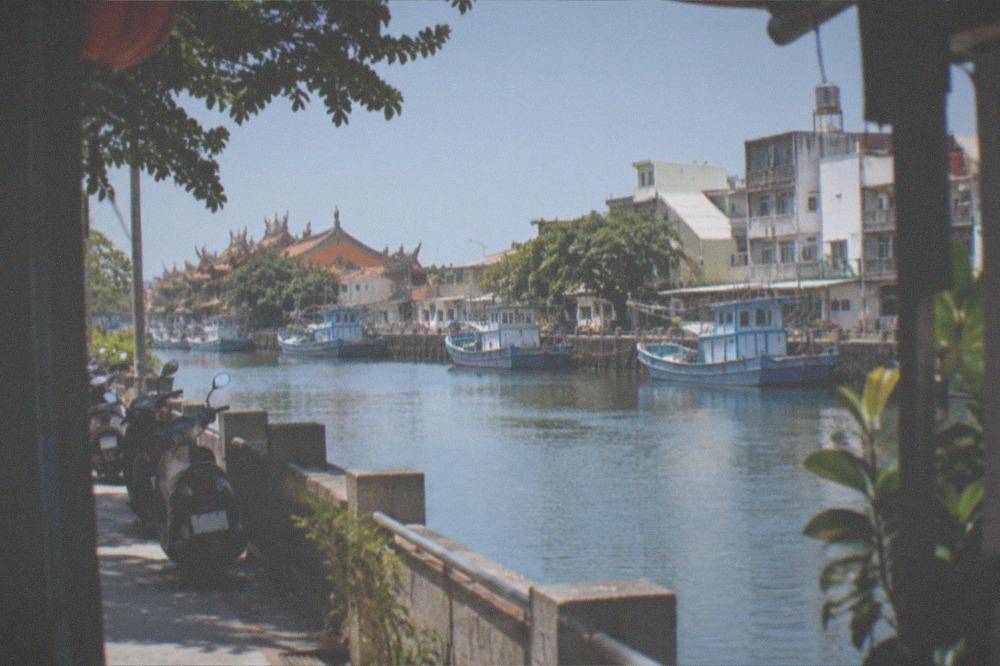
Winter, December to February, is the cool, dry season: December brings just 16.2 mm of rain, the lowest monthly total in the record. This is also, counter-intuitively, Tainan's peak for visitors. The Tourism Administration's 2023 attraction dataset shows the city's biggest draws, led by temple pilgrimage sites, peaking in January and February around Lunar New Year. The climate explains it: the dry, comfortable half of the year is when pilgrimage and outdoor temple culture are at their most practical. Crowds and weather pull in the same direction in winter, so if quiet streets matter more than festivals to you, late October and November are the better pick.
| Window | Mean max C | Wet days per month | Best for |
|---|---|---|---|
| January to February | 23.0 to 24.0 | 3.8 to 4.1 | Festivals, temples, pilgrimage season, mild sightseeing |
| March to April | 26.6 to 29.3 | 4.2 to 5.9 | Spring sightseeing before the rain builds |
| May to June | 31.4 to 32.4 | 9.0 to 12.1 | Mango season, dragon boats, early-summer heat |
| July to August | 33.0 to 32.6 | 13.0 to 15.8 | Seafood festival, summer storms, highest heat and rain |
| September | 32.4 | 8.5 | Hot but drying out, hot spring festival begins |
| October to November | 30.8 to 28.1 | 2.8 to 2.4 | The driest skies of the year, still warm |
| December | 24.4 | 3.0 | Dry, mild, the quietest weather of all |
For the full decision, including how the HSR fare and the transfer at Tainan HSR station shape arrival logistics, pair this page with our best time to visit Tainan guide, which weighs climate against crowds and festival dates.
Does Tainan Get Cold in Winter?
No month in Tainan averages a maximum below 23.0C, and the coldest month, January, still averages 17.9C overall with nights that rarely require serious winter clothing by temperate standards. December and January maxima sit at 24.4C and 23.0C, with 16.2 mm and 20.7 mm of rain. Winter in Tainan is a dry, mild season, not a cold one.
The record's winter is defined by dryness more than by temperature. December's 16.2 mm is the lowest monthly rainfall of the year, and the December to February window never averages more than 4.1 wet days a month. Humidity stays around 75 percent, so the air is not harsh, but pack a light layer for evenings: a mean of 17.9C includes cool nights, and the mean maximum is a maximum, not a guarantee.
For visitors from genuinely cold climates, Tainan's winter is the easiest season in Taiwan for walking all day. It is also the season when the city's outdoor life is at its most active, from temple festivals to the night markets, which is exactly what the visitor numbers show: the peak months are January and February, not summer.
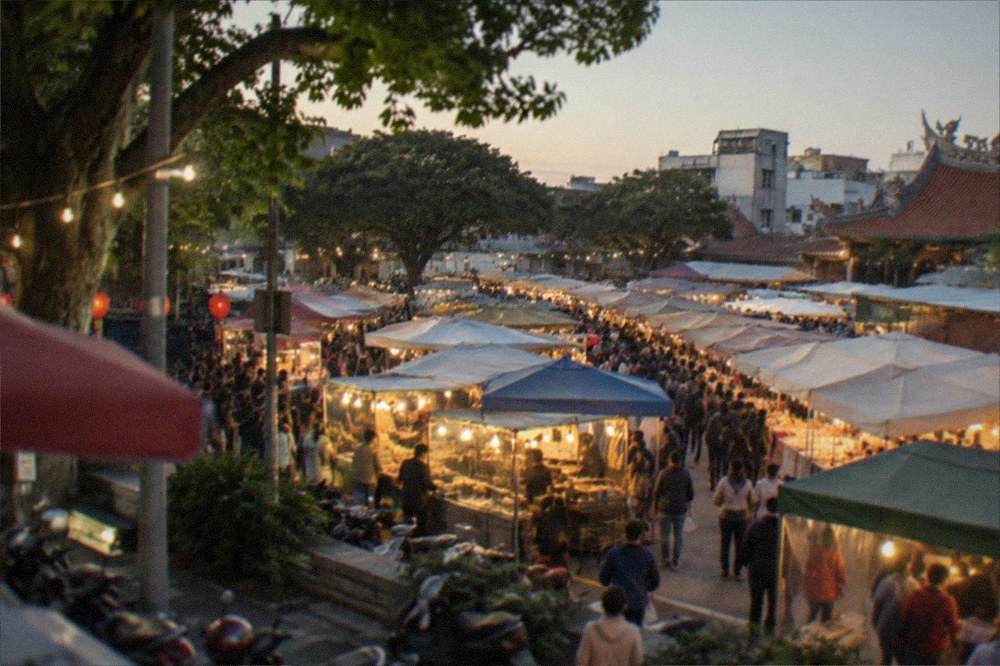
One planning note: winter is peak season for rooms as well as for temples, so booking ahead matters more around Lunar New Year than at any other point in the year.
How Does Tainan's Weather Shape a Food Night?
Tainan's night markets rotate by day of the week, so the weather only decides where you eat, not whether you eat. Garden Night Market runs Thursday to Sunday, Wusheng Wednesday, Friday and Saturday, Dadong Monday, Tuesday and Friday, and Siaobei is indoors and open every day, which makes it the wet-weather and wrong-night answer.
The rotation is the single most useful practical fact in the city, and it is verified market by market from the Tourism Bureau's own pages. Friday is the one night all three big outdoor markets run at once. Wednesday is the thinnest, with Wusheng alone. And when the summer table's 15.8 August wet days deliver an evening downpour, Siaobei, which is covered and open daily from 12:00 to 00:00, is the plan that survives the forecast. The days do change from time to time, so check before you go.
| Market | Open | Hours | Weather fit |
|---|---|---|---|
| Garden Night Market | Thursday, Friday, Saturday, Sunday | 17:00 to 00:00 | The biggest; best on a dry evening |
| Wusheng Night Market | Wednesday, Friday, Saturday | 17:00 to 00:00 | The only big market on a Wednesday |
| Dadong Night Market | Monday, Tuesday, Friday | 18:00 to 01:00 | Runs latest, into the cooler hours |
| Siaobei Night Market | Every day, indoor | 12:00 to 00:00 | The rain-proof option, open daily |
Heat shapes the food calendar too. The city's own festival calendar places the mango season in June and July, which is the start of the wet half of the year, and the Qigu Seafood Festival in July and August, at the peak of it. Both are worth planning around if you accept the weather that comes with them. The Tainan food guide and the Tainan street food pages map the dishes, from beef soup eaten at dawn to the city's bread and noodle specialties, and no dish price appears anywhere on this site because no official price list exists.
Common Questions About Tainan Weather
What is the hottest month in Tainan?
July, with a mean temperature of 29.3C and a mean maximum of 33.0C, according to the Central Weather Administration's 1991 to 2020 normals. August is fractionally cooler on average but wetter, at 466.1 mm of rain across 15.8 wet days.
What is the wettest month in Tainan?
August, at 466.1 mm of rain over 15.8 wet days. June and July follow at 370.5 mm and 374.6 mm. Together, May to September carry close to three-quarters of the annual 1,760.6 mm total.
What is the driest month in Tainan?
December, with 16.2 mm of rain across about 3 wet days. October has the fewest wet days of any month, 2.8, while still averaging 30.8C maxima, which is why the October to November window is the climate record's best stretch.
Does it rain all day in Tainan in summer?
The record measures wet days and totals, not hours, so it cannot answer that directly. What it does show is that summer rain comes in concentrated bursts: August averages 466.1 mm over 15.8 wet days, which means heavy falls rather than constant drizzle. Build a flexible indoor option, such as Siaobei Night Market or a museum, into any summer day.
Is Tainan too hot in summer for sightseeing?
It is hot, with 27 to 29 days over 30C in each of June, July, August and September, but the city's hours partly accommodate it. Chihkan Tower stays open until 21:30 daily, and the Tainan Art Museum runs until 21:00 on Saturdays, so evenings outdoors are workable even in peak heat.
When should I not visit Tainan?
No month is a write-off. June to August combines the highest heat with the heaviest rain and the concentrated typhoon risk, so it is the window that demands the most contingency planning. If your dates are fully flexible, October and November give you the driest skies of the year while staying warm.
The record, in the end, is simpler than most cities': pick the dry half of the year for walking and festivals, accept the wet half only if the mango season, the seafood festival or a summer schedule is the thing drawing you, and always check the live forecast and the market days before you go. More planning help, from arrival logistics to itineraries, is on the Tainan Travel Guide homepage.